The landscape of higher education and professional certification has experienced a dramatic transformation over the past decade. As learning management systems and web-based platforms expanded, traditional methods of evaluating student knowledge underwent rapid digitization. Today, institutions utilize a wide array of formats for educational assessment, ranging from automated quizzes to high-stakes final examinations delivered entirely online.
However, as remote evaluation tools grew widespread, significant challenges emerged regarding test equity, technological glitches, and invasive digital surveillance. In response to these growing concerns, educators, administrators, and students are re-examining the physical test environment. Rather than relying exclusively on automated software monitoring at home, many academic institutions are re-emphasizing physical campus venues. The on-campus testing center alternative offers a secure, equitable, and distraction-free environment that bridges the gap between digital convenience and rigorous evaluation integrity.
The Shift in Assessment: Exam Center vs Remote Proctoring
When distance learning accelerated, academic institutions increasingly turned to digital remote assessment tools to oversee distant test-takers. These platforms use webcams, screen recording, artificial intelligence flags, and keystroke tracking to monitor students in their personal living spaces. While remote monitoring solved immediate logistical challenges during campus closures, prolonged reliance on it exposed several fundamental drawbacks.
When analyzing exam center vs remote proctoring, the contrast between remote monitoring and structured physical environments becomes clear across several key dimensions:
- Privacy Concerns: Remote proctoring often requires room scans, facial verification, and continuous video recording inside a student's bedroom or living space. Many test-takers find this level of monitoring invasive and stressful.
- Technical Disparities: Remote testing relies heavily on the student possessing a reliable computer, a high-speed internet connection, and a functioning webcam. Minor network fluctuations can cause exam lockouts or submit incomplete tests.
- False Positives: AI-based monitoring tools frequently flag normal human behaviors—such as mumbling while reading a question, looking away from the screen to think, or background noise from family members—as suspicious activity.
- Environmental Equality: Not all students have access to a quiet, private room free from interruptions. Household noise, shared spaces, and unreliable home environments create an unfair disadvantage.
In contrast, physical testing centers eliminate these variable conditions by providing a uniform environment where every test-taker operates under identical hardware, software, and physical surroundings.
The Infrastructure of University Testing Facilities
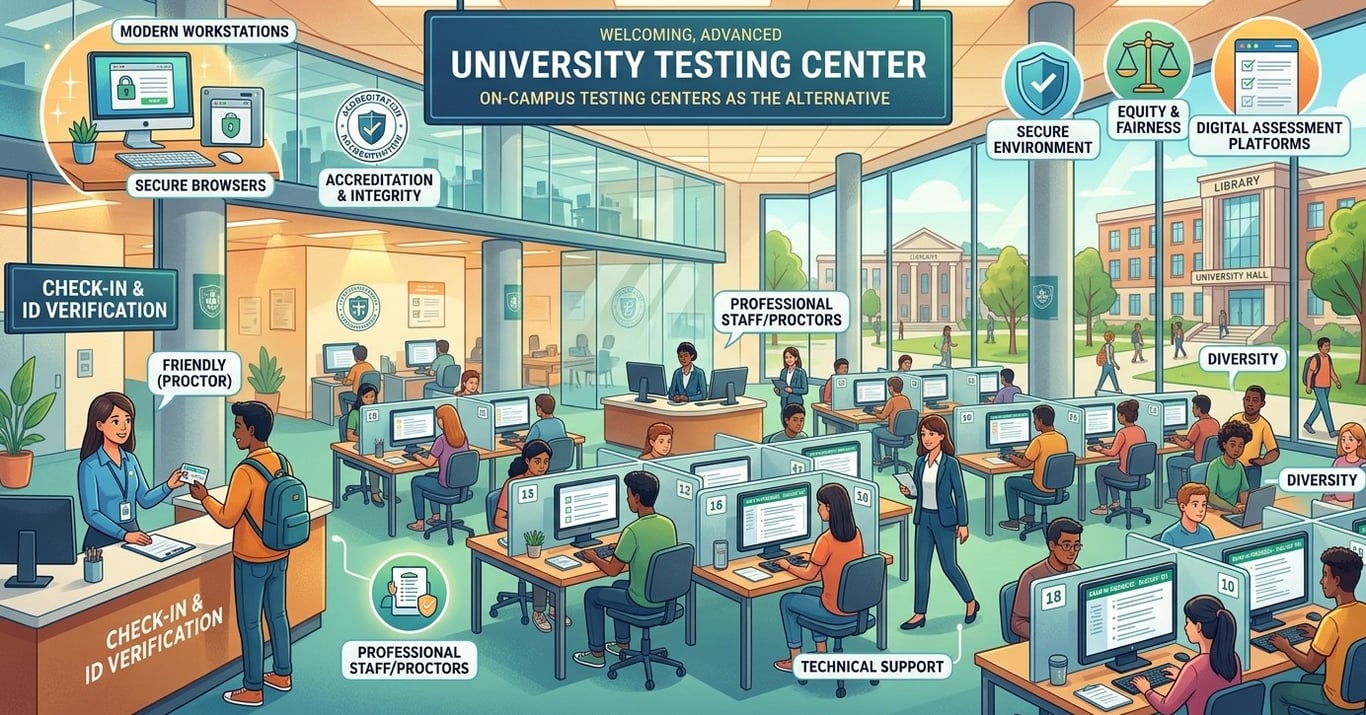
Modern university testing facilities are designed specifically to support diverse academic and professional testing needs. Rather than acting merely as computer labs with proctors, these dedicated facilities serve as comprehensive assessment hubs equipped with standardized hardware, robust security protocols, and trained staff.
Key Features of Modern Testing Centers
- Standardized Hardware and Software: Every workstation features identical monitor sizes, updated operating systems, secure lockdown browsers, and verified network connections, ensuring no student faces technical disadvantages due to equipment quality.
- Trained On-Site Proctors: Professional human proctors manage identity verification, supervise the testing room, and address technical glitches immediately without assuming academic dishonesty.
- Accessibility and Accommodations: Physical centers work directly with campus accessibility services to provide specialized accommodations, such as screen readers, adjustable desks, ergonomic seating, extended time rooms, and quiet individual testing booths.
- Secure Testing Environments: Physical facilities utilize secure check-in procedures, locker storage for personal belongings, and standardized seating layouts that safeguard exam content while maintaining academic fairness.
By consolidating resources in dedicated physical spaces, on-campus testing centers ensure that technological barriers do not interfere with an accurate evaluation of a student's actual subject mastery.
Preserving Integrity and Accreditation Literacy
Academic credentials retain their value only when stakeholders—including employers, graduate programs, and licensing boards—have confidence in the integrity of the evaluation process. Institutional trust depends heavily on accreditation literacy, which refers to an institution's understanding and implementation of formal accreditation standards, assessment security, and compliance protocols.
Accrediting bodies require universities to demonstrate that distance education credentials meet the same rigorous standards as traditional programs. Relying exclusively on remote home monitoring can expose programs to security vulnerabilities, including unauthorized secondary devices, screen-sharing workarounds, and unverified test-taker identities.
Physical on-campus testing centers address these compliance and security concerns effectively:
- Positive Identity Verification: In-person check-in requires government-issued or institutional photo identification, preventing candidate impersonation schemes.
- Controlled Hardware Perimeter: Locked-down desktop computers prevent unauthorized web browsing, messaging applications, external storage devices, or screen recording tools.
- Standardized Security Audits: Dedicated facilities adhere to strict operational guidelines established by national testing associations, providing documented audit trails for accrediting agencies.
When professional programs prepare students for high-stakes licensure—such as nursing exams, engineering board tests, or a project management certification test—the physical testing environment remains the gold standard for high-stakes evaluation.
Reducing Stress and Enhancing Equity
While remote proctoring was originally intended to offer student convenience, studies and student feedback indicate that remote monitoring software frequently increases exam-related anxiety. The pressure of maintaining eye contact with a webcam, fear of unexpected technical disconnections, and worry over false-positive flags can detract from a student's concentration and performance.
Dedicated physical test venues help relieve these psychological burdens through standard operational practices:
- Immediate Technical Support: If a computer freezes or a software error occurs in a physical center, trained staff resolve the issue on the spot or move the student to an alternate station without penalty.
- Clear Human Communication: Students can ask proctors operational questions directly, eliminating the ambiguity of dealing with automated system messages or remote chat queues.
- Separation of Study and Living Spaces: Taking an exam in a designated academic venue helps students psychologically transition into a focused mindset, keeping personal living spaces dedicated to rest and study.
- Socioeconomic Equity: Physical facilities ensure that students who cannot afford high-end personal laptops, high-speed fiber internet, or quiet private apartments receive equal access to optimal testing conditions.
By placing equity and student well-being at the forefront, on-campus testing centers create a calm, professional atmosphere where students can focus entirely on demonstrating their knowledge.
A Hybrid Model for the Future of Higher Education
As post-secondary education continues to evolve, the goal is not to eliminate digital tools entirely, but rather to use them thoughtfully. Low-stakes quizzes, informal knowledge checks, and open-book reflections can easily take place online within a learning management system. However, for major midterms, cumulative final examinations, and professional certification attempts, physical infrastructure provides unmatched security and peace of mind.
Higher education institutions are increasingly adopting flexible, hybrid testing frameworks:
- Tiered Assessment Security: Low-risk assessments remain online and unproctored, while high-stakes assessments transition to physical university facilities or vetted partner testing networks.
- Off-Campus Regional Partnerships: For true distance learners who cannot commute to the main campus, universities partner with certified regional testing centers in the National College Testing Association (NCTA) network to offer identical physical security closer to home.
- Flexible Scheduling: Modern campus testing facilities offer extended operating hours, including evenings and weekends, allowing non-traditional and working students to schedule exams around work and family commitments.
Conclusion
The evolution of academic evaluation has demonstrated that technological automation cannot fully replace structured, supportive physical environments. While remote assessment tools offer undeniable convenience for routine coursework, they introduce significant challenges regarding privacy, equity, technical reliability, and test security when applied to high-stakes examinations.
By serving as a dependable, highly secure, and supportive alternative, on-campus testing centers ensure that academic standards are maintained without compromising student dignity or mental well-being. As institutions look toward the future of education, investing in physical assessment facilities remains one of the most effective ways to preserve credential integrity, foster academic fairness, and support long-term student success.