In recent years, the rapid shift toward remote learning and online education has completely transformed how academic institutions evaluate student knowledge. While online testing offered unprecedented flexibility, it also brought a wave of digital oversight in the form of remote monitoring algorithms. Driven by frustration, anxiety, and a shared sense of existential confusion, millions of students turned to social media—specifically TikTok—to vent.
What began as individual complaints quickly evolved into a massive internet subculture. Short, satirical clips lampooning digital surveillance methods gained millions of views overnight. By analyzing the phenomenon of proctoring TikTok viral trends, we can better understand how students cope with modern academic pressures, why specific remote testing policies backfire, and how these public reactions are prompting educators to reconsider traditional testing models.
The Rise of Automated Remote Surveillance in Education
To understand why these video trends exploded, it is essential to explore how automated monitoring systems function in high-stakes testing environments. When remote learning became the standard, universities and testing boards sought technological solutions to maintain academic integrity from a distance.
Automated surveillance tools typically rely on artificial intelligence, webcams, audio recordings, and screen-tracking technology to monitor test-takers. These platforms analyze physical behavior, room environments, and computer backgrounds to detect potential dishonesty. Standard automated procedures often require students to:
- Perform a 360-degree video scan of their physical workspace using their webcam.
- Keep their eyes strictly fixed on the center of the screen without blinking excessively or looking away.
- Maintain complete, dead silence within their living space for the entire duration of the test.
- Submit to identity verification protocols, including continuous facial recognition and physical checks.
While the intended purpose was to prevent dishonesty, the reality for millions of students was a hyper-rigid, high-pressure environment where minor human behaviors—such as staring at the ceiling to think, reading a question aloud to oneself, or clearing one's throat—could trigger automated flags for suspicious activity.
Bizarre Demands: From Room Scans to Mouth Inspections
The humor found in social media critiques stems directly from how surreal these procedures can feel in practice. Among the most widely shared and heavily ridiculed requirements are funny proctoring rules that force students into absurd physical routines.
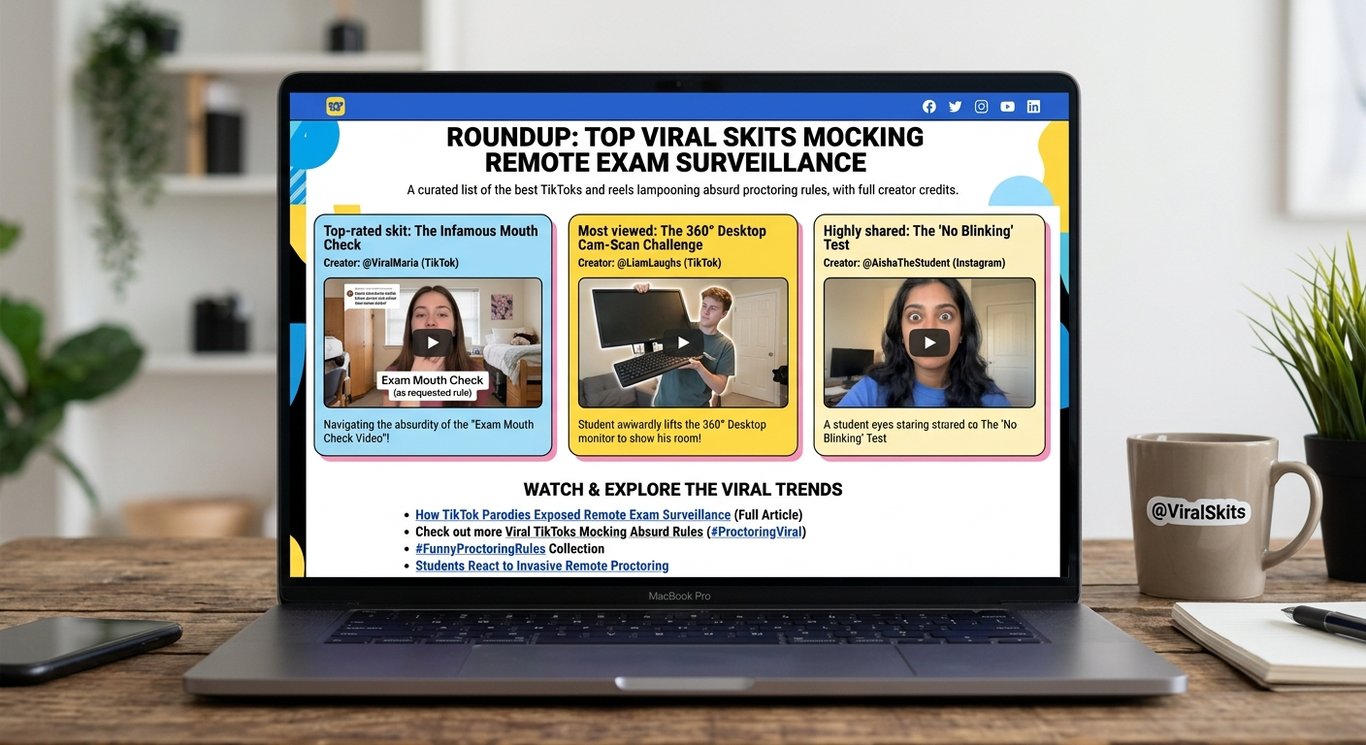
On TikTok, students regularly post comedic reenactments of their testing experiences. Some of the most popular videos feature test-takers attempting to navigate increasingly obscure instructions:
- Extreme Room Scans: Students filming themselves awkwardly lifting heavy desktop computers, massive mirrors, or entire bed frames to satisfy a webcam scan showing every corner of their room.
- Pet and Family Interruptions: Videos showcasing cats jumping onto keyboards, siblings opening bedroom doors, or parents walking in with laundry, instantly turning a standard exam into an extreme stress situation.
- Facial and Body Movement Restrictions: Clips mocking the strict gaze-tracking algorithms, where students practice looking unblinkingly at a screen like a robot so they don't get flagged for looking away to think.
Perhaps the most notorious trend involved the infamous exam mouth check video subgenre. In these clips, students record themselves—or parody the requirement of—opening their mouths wide, lifting their tongues, and turning their heads side-to-side on camera to prove they haven't hidden cheat sheets or micro-earpieces inside their mouths. TikTok creators frequently layer these videos with dramatic music or sarcastic commentary, highlighting the stark contrast between standard academic evaluation and invasive physical inspections.
Privacy, Security, and Student Backlash
Beneath the humor and satirical skits lies a very real, deep-seated concern regarding digital privacy and cyber security. Many students view automated monitoring platforms not just as strict academic tools, but as an excessive invasion of their personal space and personal data.
This vocal pushback has led a growing number of student advocates, tech experts, and privacy activists to describe remote proctoring software as spyware. Critics argue that these applications require excessive system permissions on personal laptops, including:
- Kernel-level access or deep system monitoring that can track running background processes.
- Continuous background recording of micro-phones and webcams.
- The collection and retention of sensitive biometric data, such as facial geometry and keystroke dynamics.
- Full tracking of web browsing histories, connected external hardware, and network data.
By posting comedic videos that showcase how intrusive these software packages are, students have successfully elevated what might have been isolated student complaints into a global public debate. The satire served as an effective gateway, introducing broader audiences to serious topics like algorithmic bias, data privacy rights, and student consent.
Pedagogy Under Question: Does Remote Surveillance Actually Work?
As viral skits continue to rack up millions of views, educational researchers and administrators are paying attention. The viral movement has sparked an essential question among academic institutions: does proctoring even stop cheating?
Research and practical evidence suggest that heavy digital surveillance may not be the silver bullet institutions hoped for:
1. Circumvention is Always Evolving: Technologically savvy students frequently find workarounds, from using external secondary monitors placed just out of camera range to manipulating network settings or leveraging hardware bypasses.
2. High Rate of False Positives: Algorithms frequently flag harmless human behaviors. Neurodivergent students, individuals with eye conditions, or those living in noisy, crowded households are disproportionately flagged for “suspicious movement.”
3. Increased Test Anxiety: Studies show that being constantly watched by a camera and an algorithm significantly increases cognitive load and anxiety. Students end up spending vital mental energy worrying about where their eyes are pointed rather than focusing on answering questions.
4. Equity Issues: Students without access to high-speed internet, quiet private bedrooms, or modern webcams face severe academic disadvantages under rigid automated systems.
Moving Forward: Rethinking Educational Assessment
The cultural impact of these viral trends reaches far beyond short-form video entertainment. By exposing the absurdities and technical limitations of automated surveillance, social media creator culture has accelerated an overdue conversation regarding authentic learning.
Educators worldwide are now actively engaged in rethinking educational assessment for a digital-first world. Instead of trying to turn a student's bedroom into a high-security testing facility, forward-thinking institutions are adopting alternative, highly effective evaluation methods:
- Open-Book and Applied Knowledge Exams: Designing assessments that allow students to use notes, textbooks, and search engines. These tests evaluate critical thinking, synthesis, and problem-solving rather than rote memorization.
- Project-Based Learning: Evaluating student progress through long-term research projects, coding repositories, portfolios, or design presentations that cannot be easily faked or automated.
- Frequent, Low-Stakes Quizzes: Replacing massive, high-stress midterm and final exams with smaller, continuous assessments that reduce the temptation to cheat.
- Oral Defense and Discussions: Incorporating brief individual or small-group verbal check-ins where students explain their reasoning and thought processes directly to an instructor.
Conclusion
What started as comedic relief on TikTok—ranging from dramatic parodies of the exam mouth check video to skits highlighting absurd room inspection demands—has evolved into a powerful catalyst for institutional reform. Through humor and collective solidarity, students exposed the operational failures, privacy risks, and emotional stress associated with automated surveillance.
As higher education continues to adapt to an increasingly digital environment, the message from the student body is clear: effective learning cannot be enforced through invasive surveillance. By moving away from hyper-strict automated monitoring and focusing on holistic, authentic assessment strategies, educators can build an academic environment grounded in trust, equity, and genuine intellectual growth.